
You notice a dark spot on a shingle after a storm. A few granules are missing, and the mark looks roughly round. Is it hail damage?
It could be, but that description can also fit a blister that has opened. The useful distinction is what happened to the shingle surface, along with what the rest of the roof shows. A close-up photo can help explain the difference. It rarely tells the whole story.
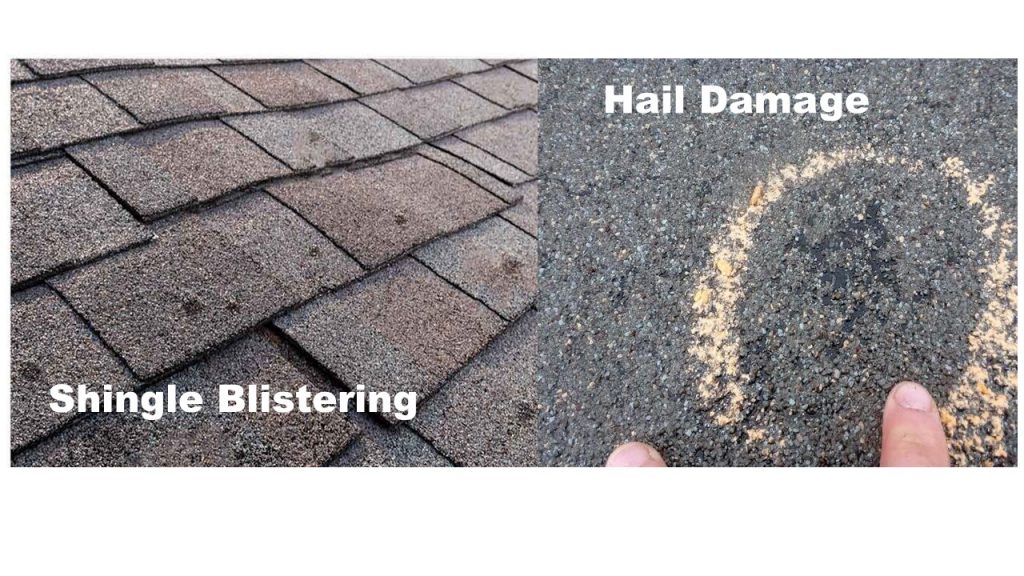
What a shingle blister looks like
An intact blister is a raised, bubble-like area on the shingle. GAF identifies trapped moisture and excess roofing cement beneath the shingles as common causes. A blister alone does not establish a manufacturing defect or a ventilation problem; the cause needs its own evaluation. [1]
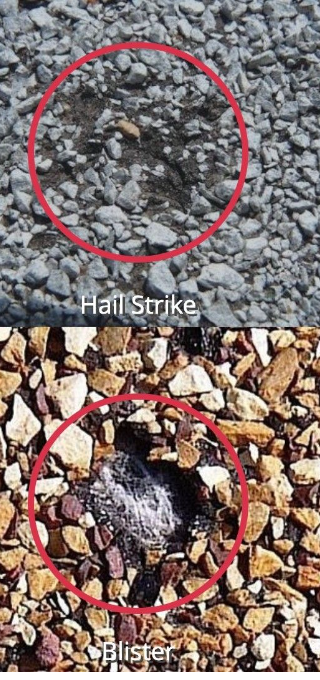
When the blister opens, it can leave a bare spot or small crater where part of the surface has come away. CertainTeed describes both closed blisters and open blisters that expose asphalt. This is where the confusion starts: an opened blister can look like an impact mark, particularly in a photo with little surrounding detail. [2]
Nearby intact bumps can help explain the open spots. Look at their edges and surrounding surface, too, rather than deciding from the circular shape alone.
What hail can do to a shingle
Hail strikes the shingle from above. Depending on the impact and the condition of the material, signs can include an indentation, a fracture, or an area where granules have loosened or come off. Owens Corning also notes that some granule loss may become apparent later as loosened granules work free. [3]
There is no single appearance that every hail-damaged shingle must have. A visible dent or crack can be useful evidence, but its absence does not settle the question. In a 2025 laboratory study, IBHS researchers found that repeated impacts from small ice spheres caused granule loss without observable dents or tears. Those test results do not diagnose a particular roof, but they show why an inspection should not depend on one visual sign. [4]
How to compare the two
Start with the mark, then widen the view. A useful inspection should answer these questions:
Is the surface raised, opened, or disrupted by impact?
A remaining blister cap or nearby raised bumps can support a blistering explanation. An indentation or fracture can support an impact explanation. Weathering can make either condition harder to read, so treat these as clues rather than a pass-or-fail test.
What is happening around the mark?
Compare several shingles and more than one roof slope. Record where the conditions occur and where they do not. Hail damage can vary across a roof and from one property to the next. A few selected close-ups should not stand in for an inspection of the whole roof. [3]
Is there other evidence of hail impact?
Dents in vents, gutters, or other exposed metal can support the finding that hail struck the property. They do not prove that every mark on a shingle came from hail, and undented metal does not automatically rule out shingle damage. The shingle condition still needs to be evaluated on its own. [3]
Could something else explain the granule loss?
Granules also come off through normal weathering, foot traffic, and other causes. GAF notes that new shingles can shed excess granules as well. Loose granules in a gutter, by themselves, do not establish hail damage. [1]
Why the distinction matters
The cause affects what needs attention next. If blistering is present, the roof may need an evaluation of the shingles and the conditions contributing to it. If hail damage is present, the inspection should document its extent and the appropriate repair options. Both conditions can exist on the same roof.
An open blister should not be dismissed just because it is not hail damage. CertainTeed warns that open blisters exposing asphalt can increase the risk of premature deterioration. At the same time, a surface mark does not automatically mean the entire roof needs replacement. The recommendation should fit the condition and extent of the problem. [2]
What homeowners should do
Stay on the ground. Take photos of safely visible damage, note when you first noticed it, and save any earlier roof photos. Do not scrape the surface, press on blisters, or climb onto the roof to test a suspected hail mark.
Ask the person inspecting your roof to show you both close-up and wider photos, explain which features support the conclusion, and identify anything that remains uncertain. If the roof is leaking, arrange prompt professional attention rather than waiting to settle the cause.
The goal is a clear explanation of what is on your roof and what, if anything, needs to be done. Ask for the evidence behind the answer.
Why attic ventilation is a big deal
From what we see in the field, poor attic ventilation is one of the biggest contributors to roofs wearing out too soon. It deserves attention, whether or not the roof has hail damage.
Heat or moisture buildup related to inadequate ventilation can contribute to shingle blistering. It is one possible cause, so the condition of the roof and attic should be evaluated before drawing a conclusion. [1, 2]
Stay tuned for our next article to learn about ventilation on your home, why it matters, and what to look for.
Sources
2. CertainTeed, The Life Cycle of Your Roof. Blisters and Material Concerns.
3. Owens Corning, Hail Damage Technical Bulletin, February 2025.